
Residual solvents in peptide raw materials: read the test basis
Read peptide residual-solvent reports by solvent identity, units, method scope and reporting basis. Understand the scope of ICH Q3C(R9) and its Option 1 values.
5 min read · Sources checked 2026-10-31
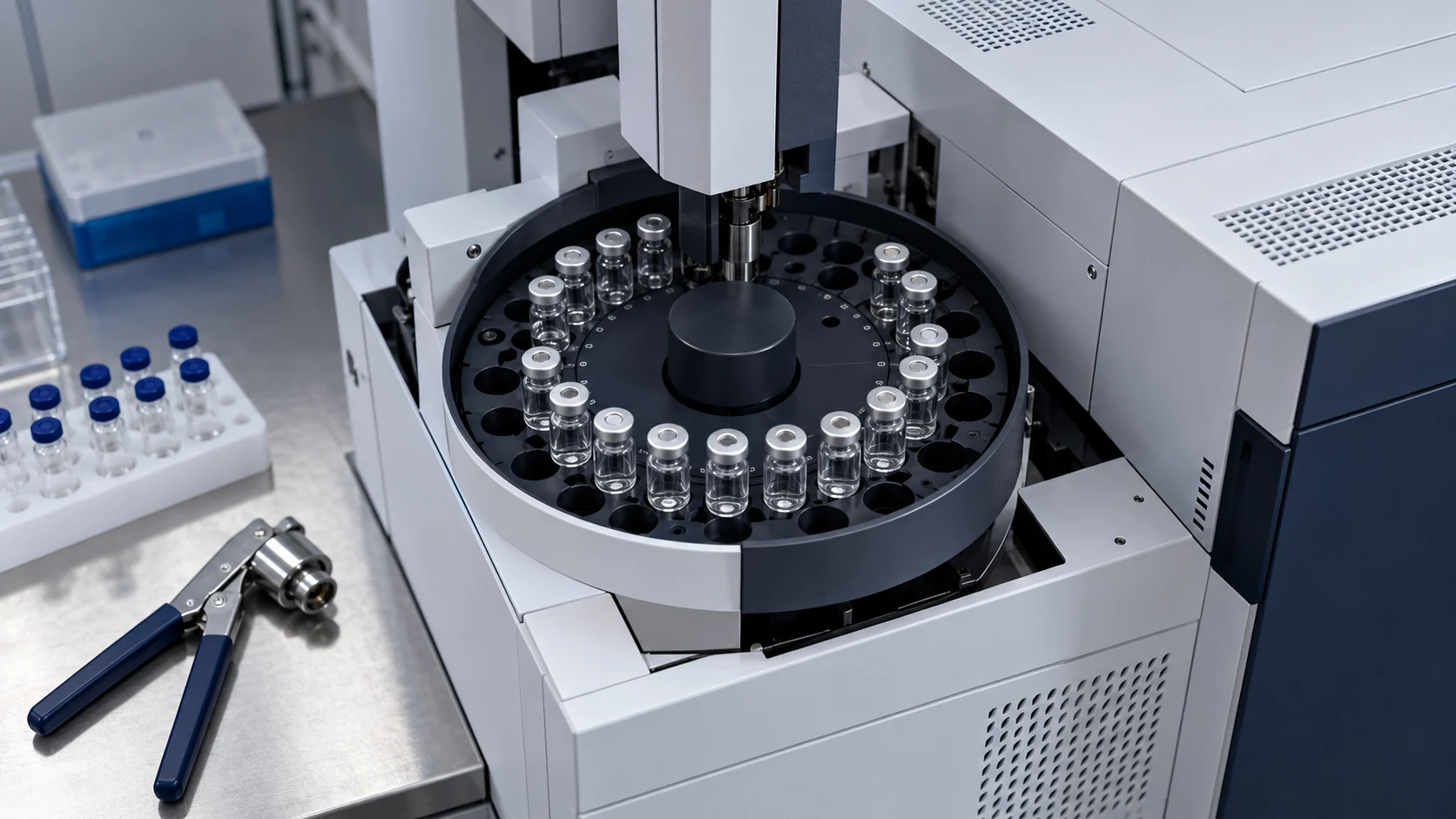
A residual-solvent report for a peptide raw material should name the solvents assessed, the analytical procedure, the result units and the material basis. A general statement that a sample was “solvent tested” leaves the scope of the result unclear.
Build the solvent list from the supply history
Ask which solvents may remain from the actual manufacturing and purification route. A standard screening panel can be useful, but its list needs to cover the material under review. When the route changes, repeat that discussion even if the catalogue name and appearance stay the same.
The enquiry should identify whether the sample is an isolated powder, a formulated lyophilised presentation or another preparation. This affects how a result relates to the mass received. Keep any carrier or other component visible in the material description. Procurement cannot reconstruct the denominator from a chromatogram alone.
Distinguish a solvent result from a counter-ion statement
Commercial documents sometimes combine several different questions under a general impurity heading. Ask the laboratory to state whether it measured named volatile solvents, a counter-ion or another residual component. A report for one of those purposes should not be treated as a complete answer to the others.
Read ICH Q3C values within their pharmaceutical scope
ICH Q3C(R9), dated 24 January 2024, addresses residual solvents in pharmaceuticals. For acetonitrile, it lists a permitted daily exposure of 4.1 mg/day and an Option 1 concentration of 410 ppm. Option 1 uses an assumed product mass of 10 g/day. The Class 3 discussion relates 5000 ppm, or 0.5%, to that same exposure context. These figures explain the guideline; they are not universal research-peptide release limits or instructions for administering a material. [1]
A quotation that says “Q3C compliant” still needs to identify the solvent list, agreed specification and applicable basis. For a research enquiry, put the intended laboratory application and required evidence in the order. Any regulated product project needs its own responsible quality and regulatory assessment.
Check units before comparing reports
For a mass-fraction result, 1 ppm is equivalent to 1 microgram per gram. Consider a hypothetical result of 200 ppm in an as-received sample weighing 0.50 g:
200 micrograms/g × 0.50 g = 100 micrograms of the named solvent
This is a unit-conversion example, not a supplied-lot result or an acceptance recommendation. The calculation works only if the laboratory’s ppm value is a mass fraction on the stated basis. A concentration reported in the prepared analytical solution needs the appropriate preparation calculation before it can describe the original material.
Ask what “not detected” means
A report should connect that phrase to a named analyte, a method and a stated detection or reporting limit. A numerical value below a laboratory’s quantitation limit has a different status from a reliable quantified result. Keep those statuses separate when entering values into a supplier-comparison sheet.
For example, two hypothetical suppliers could report “not detected” and “below the quantitation limit” for the same solvent. Those statements cannot be ranked until the limits and reporting conventions are known. A more detailed report can look less reassuring while actually providing more useful information.
Define what the analytical procedure covers
| Report item | Question to ask | Record to retain |
|---|---|---|
| Analyte list | Which named solvents were assessed? | Panel or method scope linked to the material route. |
| Procedure | Which method and revision generated the result? | Laboratory reference and applicable suitability information. |
| Quantitation | Can the method support the agreed limit? | Relevant range and quantitation limit for each analyte. |
| Units and basis | Does the result describe the original material? | Mass fraction, preparation basis and any stated correction. |
| Lot linkage | Which delivered lot was sampled? | Sample receipt, supplier lot and report identifier. |
Q3C(R9) discusses chromatographic procedures, including gas chromatography, and explicitly includes solvent volatility as a method-validation consideration. Naming headspace GC therefore describes an approach, not proof that every relevant solvent is covered. [1] ICH Q2(R2) provides the broader framework for matching the measurement range and selectivity to the analytical purpose. [2]
Resolve the purchasing decision before approving the report
- Confirm the actual material form and offered lot.
- Agree which residual components require separate results.
- Check that the analytical scope covers the named solvents.
- Record result units, basis and reporting limits.
- Assign ownership for interpreting any result outside the agreed specification.
Keep the residual-solvent review with the broader batch COA review. For additional testing, send the analyte list to analytical services. A lyophilised powder development brief should also state whether the requested presentation changes the material basis used in the report.
Frequently asked questions
Does 5000 ppm apply to every residual solvent in a peptide?
No. The often quoted 5000 ppm value belongs to the Class 3 discussion under the pharmaceutical Option 1 context in Q3C. Solvent identity, classification and the relevant application must be established.
Is an HPLC purity result a residual-solvent result?
A chromatographic purity percentage and a named residual-solvent measurement answer different questions. Ask which procedure measures the solvents of interest and how its results are reported for the original material.
What does a solvent result reported as not detected establish?
It establishes a finding only within the named method and its detection or reporting limit. Request those details before comparing it with a quantified value or a result below another method's quantitation limit.
Can a route change require a new residual-solvent review?
Yes. Review whether the list of relevant solvents and the analytical coverage still match the changed route. Keep the decision with the specification revision and the first affected lots.
Sources and further reading
- ICH: Q3C(R9): Impurities, Guideline for Residual Solvents, 24 January 2024
- FDA / ICH: Q2(R2): Validation of Analytical Procedures, March 2024
Sources checked on 31 October 2026. The cited standards, guidance and studies have their own application scopes. They do not certify our products or establish batch results.