
Dissolving microneedle patches: mechanical and insertion evidence
Specify mechanical and insertion evidence for dissolving microneedle patch development. Review array geometry, force reporting, model limits and post-test records.
6 min read · Sources checked 2026-10-31
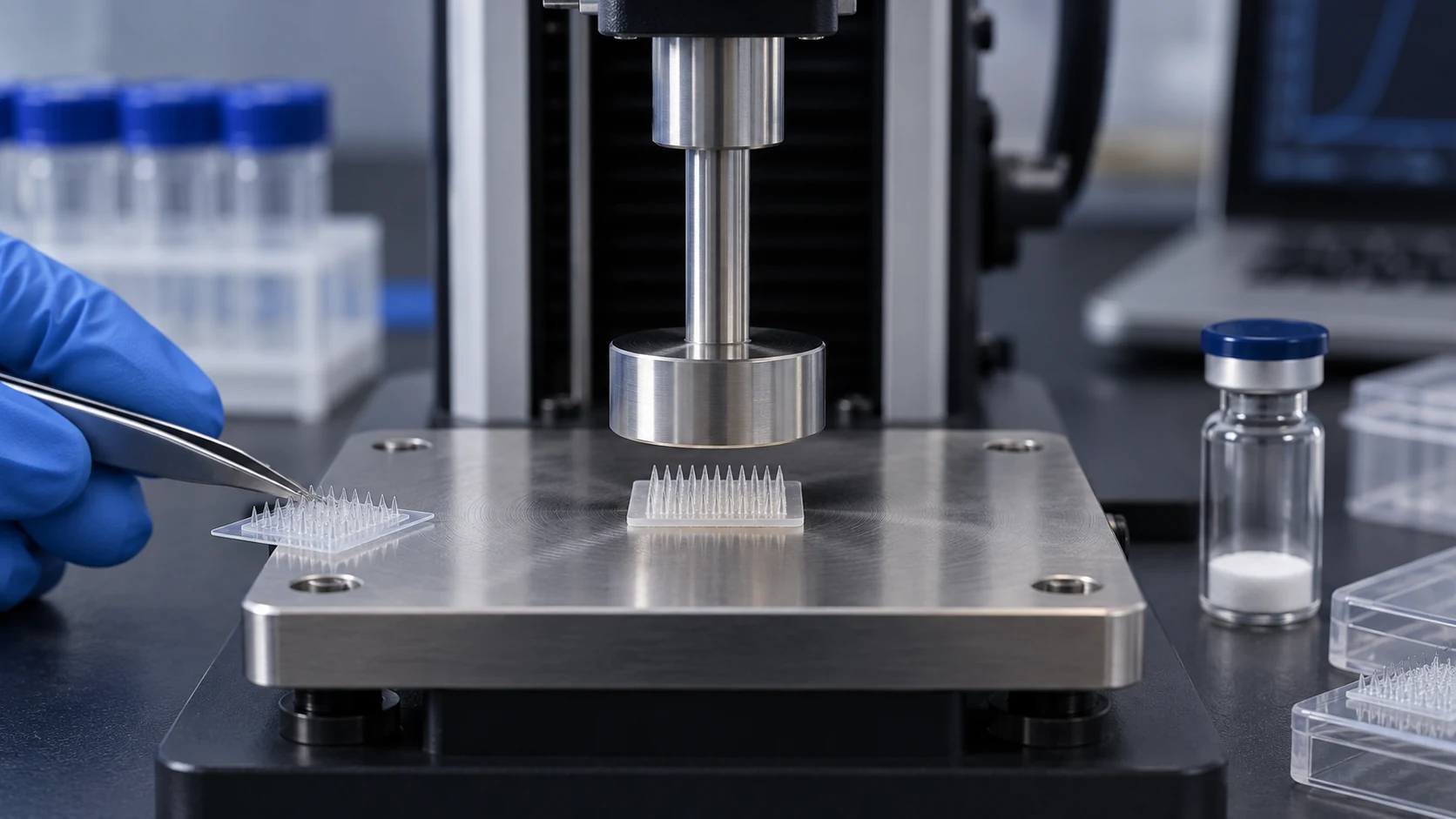
A dissolving microneedle development brief should distinguish mechanical strength, insertion behaviour and the condition of the array after testing. The test record needs a defined geometry, specimen condition, method and acceptance question. A photograph of sharp tips does not establish those attributes.
Identify the array that was actually tested
Record the design revision, material composition, nominal geometry, number of needles and backing construction. Keep the prototype lot and conditioning history with the result. The same commercial project name can cover several designs during development, so a project name alone is a weak specimen identifier.
Connect the measurement to the decision. A prototype comparison may ask whether one design deforms more than another under the same conditions. A later specification review may ask whether a fixed design meets an agreed criterion. Keep those purposes distinct when choosing how much testing and documentation the laboratory needs.
Use scale and orientation in the image record
Ask for consistent before-and-after views with a scale reference. Tip appearance, backing distortion and array alignment should be assessable in the same record. A selected close-up of one intact needle cannot describe the condition of the full array after a test.
Separate compression behaviour from insertion behaviour
Yan and colleagues’ 2021 study combined material measurements, compression assessment and finite-element analysis when investigating dissolving microneedles. Its comparisons concerned the materials and geometries within that study. [1] For a supplier review, the useful lesson is to request the conditions behind a mechanical result before treating it as an acceptance limit for another array.
A compression record should state what was loaded and what the reported force describes. Insertion work should identify the test substrate and how the result was assessed. Combining the two into a single statement such as “passes strength testing” hides the question each experiment answered.
| Assessment | Record to request | Decision boundary |
|---|---|---|
| Array geometry | Design revision, dimensions and representative images. | Describes the specimen; does not establish insertion. |
| Mechanical response | Force basis, test configuration and post-test condition. | Supports the stated loading comparison. |
| Model insertion | Substrate, assessment method and observed penetration record. | Applies to the defined model and setup. |
| Application-specific assessment | Protocol and endpoints appropriate to the intended product. | Needs separate evidence for the proposed claims. |
Keep force per array and force per needle distinct
In a hypothetical arithmetic example, dividing a total force of 10 N by an array of 100 needles gives an average of 0.1 N per needle. That calculation does not establish that each needle experienced the same load. It also provides no pass criterion for a real product. Retain the total force and array size when a report includes a normalised figure.
If two prototype reports use different denominators, reconcile the basis before ranking them. Ask whether the same portion of the array contacted the test surface and whether the images show alignment problems. A single headline number should not replace the underlying specimen and setup record.
State what an insertion model represents
Larrañeta and colleagues evaluated Parafilm M as a model membrane and compared insertion findings with excised neonatal porcine skin. The paper describes a practical model for controlled development comparisons. [2] A supplier should identify which model it used and explain the scope of the resulting conclusion.
Keep a model result attached to its conditions. Penetration observed in a film stack does not, by itself, establish penetration depth in human skin, an ingredient-delivery percentage or a clinical effect. Those claims need evidence addressing their own endpoints. A development image should not acquire those claims when it moves into packaging or website copy.
Plan how changes will be compared
When the project changes the polymer preparation, needle geometry or backing, identify which earlier results still describe the new design. Record the change and the reason for the follow-up assessment. A comparison is easier to interpret when the unchanged aspects of the setup are documented as carefully as the design change.
Keep mechanical and insertion records separate from dissolution observations and material compatibility work. A project may need all of them, but one endpoint should not silently stand in for another. If ingredients are present, identify whether the tested specimen contains the proposed preparation or an unloaded development material.
Resolve the product pathway before making safety claims
For a project classified as a medical device, ISO 10993-1 provides a framework for biological safety evaluation within risk management. Its public scope concerns that evaluation, not mechanical insertion performance or a certificate for any named patch. [3] Product classification and applicable market requirements need a separate review before a team decides what supporting programme is required.
Prepare an OEM or ODM evidence request
- Provide the design revision, proposed material and intended product category.
- Name the prototype comparison or acceptance decision the work should support.
- Request method references and specimen-conditioning records.
- Keep force basis, model identification and before-and-after images with each result.
- Agree the endpoints that need separate dissolution, compatibility or safety assessment.
- Assign approval of technical conclusions and outward-facing claims.
Send those requirements with the microneedle patch development enquiry. The OEM project questions cover the wider product brief, while the moisture-barrier packaging guide explains how to frame packaging evidence for moisture-sensitive development formats. Confirm the exact patch packaging scope with the project team rather than transferring an oral-format result unchanged.
Frequently asked questions
Is there one mechanical pass force for every dissolving microneedle patch?
A useful criterion depends on the defined array, materials, test setup and intended decision. Request the conditions and evidence supporting the proposed criterion instead of transferring a number from another design.
Does a Parafilm insertion result prove delivery through human skin?
No. It is a finding in a defined model. Human insertion, delivered amount and any clinical or cosmetic claim require evidence addressing those particular endpoints.
What should accompany a force-per-needle result?
Retain the total force, array size, test configuration and specimen record. A normalised average does not establish equal loading of every needle or provide a universal acceptance threshold.
Which records help compare two microneedle prototypes?
Use clearly identified design revisions, material and conditioning records, matched method references, representative before-and-after images and endpoint-specific results. Explain any setup differences before comparing the numbers.
Sources and further reading
- Yan et al., Polymers (2021): Finite Element Analysis for Biodegradable Dissolving Microneedle Materials on Skin Puncture and Mechanical Performance Evaluation; DOI 10.3390/polym13183043
- Larrañeta et al., International Journal of Pharmaceutics (2014): A proposed model membrane and test method for microneedle insertion studies; DOI 10.1016/j.ijpharm.2014.05.042
- ISO: ISO 10993-1:2025, biological evaluation of medical devices, public scope
Sources checked on 31 October 2026. The cited standards, guidance and studies have their own application scopes. They do not certify our products or establish batch results.