
Oral film and pouch packaging: WVTR, seals and moisture budgets
Interpret WVTR, pouch seals and package area for oral film and oral pouch projects. Build a moisture-barrier specification around the finished package.
5 min read · Sources checked 2026-10-22
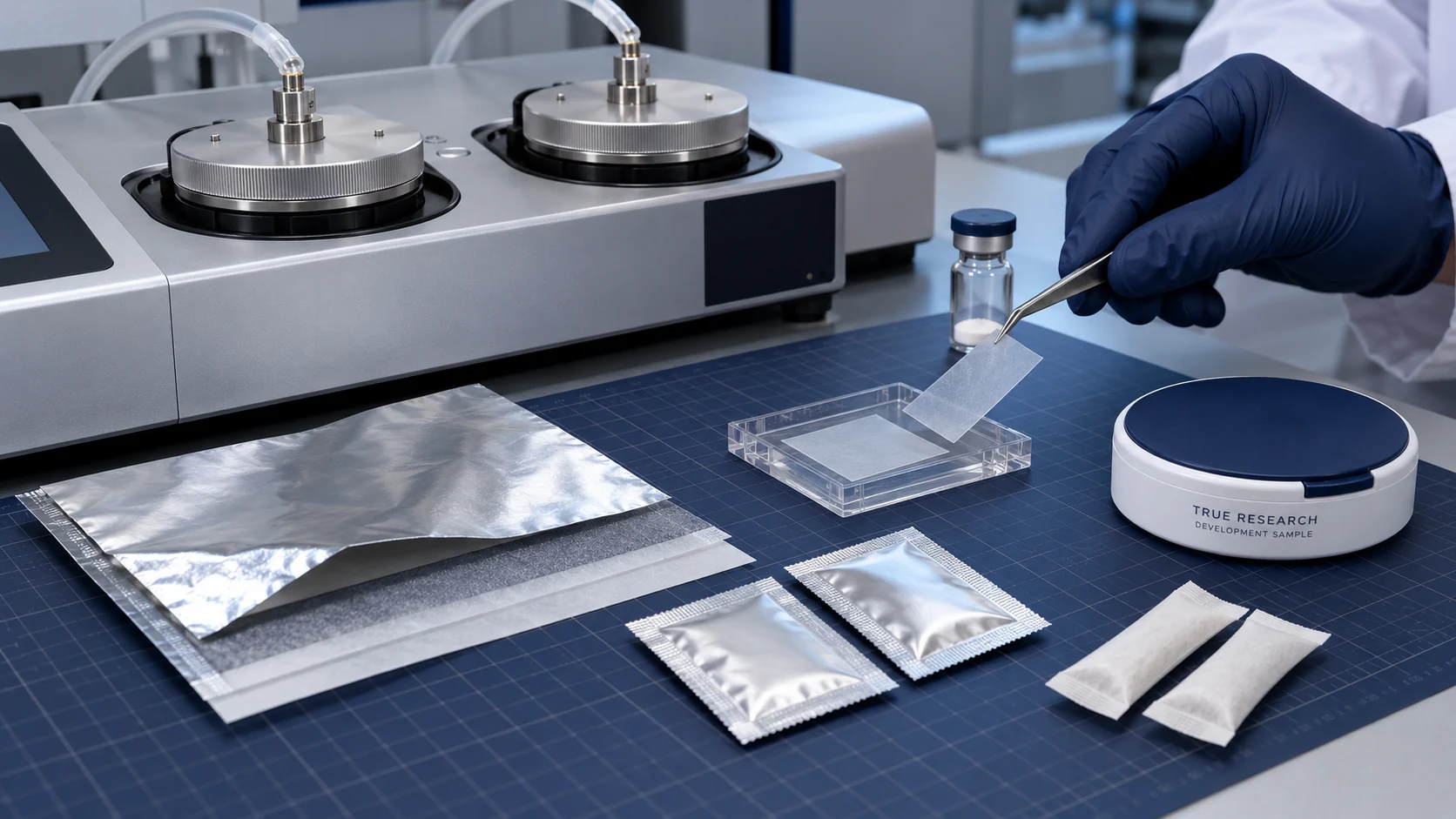
A moisture-barrier specification needs a material construction, a stated water-vapour test method and conditions, and a review of the finished package. Film transmission data, seal performance and the way a container is opened answer different parts of the packaging question.
Define what the package has to protect
An oral film is a continuous thin structure. An oral pouch contains a fill within a separate substrate. Their geometry, handling and intended material properties differ, so one packaging specification should not be copied across the two formats without review.
Begin with the product attributes that a moisture change could affect. The development team might need to assess film handling, visible changes, fill condition or another agreed property. Put the evaluation criterion into the brief before a packaging supplier proposes a barrier material. A low transmission number has little purchasing value until it connects to a product requirement.
Distinguish the sample wrapper from the commercial package
An individually sealed film sachet, a sealed pouch refill and a repeatedly opened round container create different exposure histories. A prototype that arrives in a temporary laboratory bag cannot establish performance in a different commercial package. Identify the exact package configuration in every comparison.
Read a WVTR value with its units and conditions
Water-vapour transmission rate describes moisture transfer through a barrier over area and time. Packaging reports commonly express WVTR in grams per square metre per day. ASTM F1249 covers water-vapour transmission through flexible barrier materials using a modulated infrared sensor. [1]
Keep the test conditions with the number. Ask for the temperature, relative-humidity conditions, material orientation, construction and test-method edition. Two figures taken under different conditions cannot establish a clean ranking between two laminates. The supplier should also identify any measurement-range limitation relevant to a very low reported value.
| Specification field | What it makes clear |
|---|---|
| Layer construction and material reference | Which laminate or coating was tested. |
| WVTR, units and method edition | Which measurement the number represents. |
| Temperature and humidity conditions | The conditions under which the comparison applies. |
| Total exposed package area | How the material result relates to the chosen package geometry. |
| Seal and opening configuration | Which parts of finished-package behaviour still need evaluation. |
Use area calculations to frame a moisture budget
An area calculation can make a supplier discussion more precise. Consider an illustrative WVTR of 0.05 g/(m²·day) and a total exposed film area of 0.01 m² under matching conditions. The idealised calculation is:
0.05 × 0.01 = 0.0005 g/day = 0.5 mg/day
These are hypothetical figures, not measurements of our packaging. The calculation concerns transmission through the assumed film area. It omits the effects of seals, defects, changing humidity, product moisture sorption and opening the package. It therefore cannot assign a shelf life.
The useful next question is how much moisture change the actual product can tolerate while retaining its agreed properties. The development team can then decide whether the proposed barrier and package configuration deserve further evaluation. Include both faces when calculating the exposed area of a two-panel sachet.
Assess seals separately from the barrier film
ASTM F88/F88M addresses the strength of seals in flexible barrier materials and the force and failure behaviour observed when a sealed strip is separated. [2] That result addresses a different property from transmission through the film. A laminate datasheet cannot answer whether the converted package has consistent seals.
Ask what a seal result represents
Record the tested package construction, the method and the reported failure mode. Ask the packaging specialist to relate the result to handling and opening requirements. A high force value alone does not describe the user’s ability to open an individual sachet or the whole package’s protection during storage.
For a round pouch container, include the opening and reclosure pattern in the evaluation brief. A barrier result for an unopened refill does not describe exposure after that refill enters a container that is opened repeatedly. Keep those use configurations separate in the development record.
Request evidence for the finished format
- Identify the exact laminate, container and closure configuration.
- Keep the material’s transmission report with its conditions and method edition.
- Define the seal or closure properties the project needs to evaluate.
- Agree product-specific stability observations and their acceptance criteria.
- Record which package and product versions the resulting conclusion covers.
Connect the packaging brief to oral film development or oral pouch development. For an OEM enquiry, send the proposed package configuration together with the product brief through OEM and ODM project support. The development format and its destination-market category should be defined before label claims are approved.
Frequently asked questions
Does a lower WVTR always give a longer shelf life?
A lower value under comparable conditions describes a better moisture barrier for that test. Shelf life also depends on the product, finished package, seals, exposure history and the acceptance criteria used in stability work.
Can two WVTR reports be compared if their humidity conditions differ?
Keep the conditions with each result and ask the packaging specialist to justify the comparison. The figures alone do not establish an equivalent test or a reliable ranking.
Does a film datasheet prove that the finished pouch is sealed properly?
No. Film transmission and seal performance are different properties. Evaluate the converted package and its seal or closure requirements as part of the development brief.
Should oral films and oral pouches use the same packaging specification?
Review each format separately. Product structure, individual wrapping, container opening and moisture tolerance can differ, so the package evidence must match the actual configuration.
Sources and further reading
- ASTM International: ASTM F1249, water-vapour transmission through flexible barrier materials
- ASTM International: ASTM F88/F88M-23, seal strength of flexible barrier materials
Sources checked on 22 October 2026. External references support the stated definitions and examples; they do not certify our products or facilities.